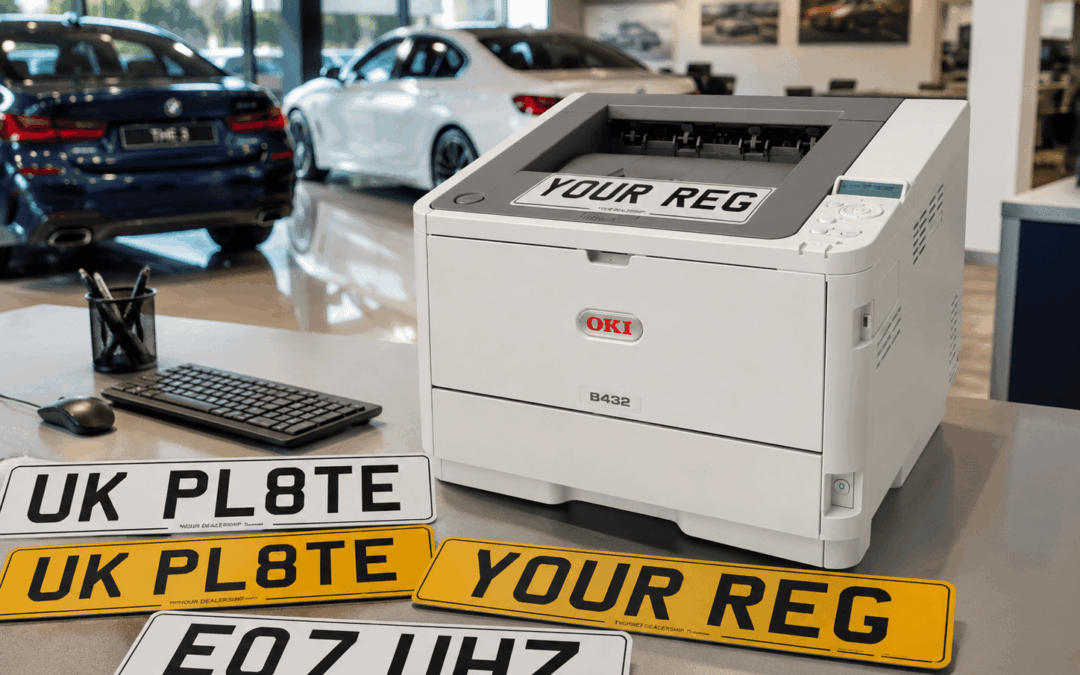
If you are looking into printing your own number plates, whether for a garage, a car dealership, a fast fit centre or a print shop taking on new work, you will quickly find there is more to it than simply loading a printer with plastic sheets. UK registration plates have to meet British Standard BS AU 145e, and the printer, ink and media you choose all play a part in whether the finished plate is legal, durable and sharp enough to pass inspection. This guide walks through everything you need to know about registration plate printing, from the legal basics to choosing the right printer for your volume and budget.
What Is Number Plate Printing?
Number plate printing is the process of producing the reflective plastic plates that display a vehicle’s registration number, using a digital printer rather than pressed or stamped lettering. Modern registration plate printers use toner or specialist ink to print directly onto pre cut, reflective polycarbonate or acrylic blanks. The result is a plate that meets DVLA and British Standard requirements while being far quicker and more cost effective to produce in house than ordering pre made plates from a third party supplier.
This approach has become popular with auto locksmiths, tyre and exhaust centres, valeting businesses and independent print shops, since it turns number plates into an additional revenue stream that can be fulfilled on demand, often while the customer waits.
Legal Requirements for UK Number Plates

Before investing in equipment, it is worth understanding what the law actually requires. Registration plates sold in the UK must comply with British Standard BS AU 145e, which covers font, spacing, reflectivity, material thickness and the retro reflective properties of the plate. Suppliers registered with the DVLA’s Register of Number Plate Suppliers (RNPS) must also verify the identity of the customer and the vehicle details before producing a plate, and must keep records of every sale.
If you intend to sell printed number plates to the public rather than just producing them for your own fleet, you will need to register as an RNPS supplier. This is a straightforward process through the DVLA, but it is a legal requirement, not an optional extra, so it is worth doing before you take your first customer order.
What You Need to Get Started
A complete number plate printing setup has four main components, and getting each one right matters as much as the printer itself.
The printer. You need a printer capable of handling rigid or semi rigid plate blanks rather than standard paper stock, with consistent, sharp black text and enough throughput for your expected volume. OKI’s range of colour LED printers, including the C650 and Pro9542 series, are widely used in the number plate trade because they combine precise text reproduction with the ability to feed thicker specialist media.
Plate blanks and reflective media. These need to meet BS AU 145e reflectivity standards. Front plates are printed on a white reflective background and rear plates on a yellow reflective background, both with black lettering in the approved Charles Wright font.
Number plate design software. Dedicated plate design software lets you enter a registration number, apply the correct spacing and font, add optional badges such as national flags or identifiers, and send the finished design straight to the printer in the correct layout.
Lamination or a protective finish. Many businesses apply a protective laminate to the finished plate to improve scratch resistance and longevity, particularly for plates that will spend years exposed to the weather.
Choosing the Right Printer for Your Volume
The right printer largely comes down to how many plates you expect to produce each week. A small garage adding plates as an occasional extra service has very different needs from a dedicated print shop turning out dozens of plates a day.
For lower volume or occasional use, a compact colour LED printer such as the OKI C651dn offers reliable, sharp black text at a lower upfront cost, making it a sensible starting point for businesses testing the waters with plate printing.
For higher volume operations, or where speed and consistency across hundreds of plates matters most, a workhorse printer built for continuous use will pay for itself quickly in reduced downtime and consistent print quality plate after plate.
Whichever printer you choose, check that it is rated to handle the thickness of the plate blanks you intend to use, since feeding media that is too rigid through a printer not designed for it is one of the most common causes of jams and print quality issues in this trade.
Step by Step: Printing a Compliant Number Plate
Once your equipment is set up, the day to day process for producing a single plate typically looks like this.
First, confirm the customer’s vehicle details against valid proof of entitlement, such as a V5C logbook or new keeper supplement, as required under RNPS rules. Second, enter the registration number into your plate design software, which will automatically apply the correct spacing, font and layout for front or rear plates. Third, load the appropriate reflective blank, white for the front plate and yellow for the rear, into the printer. Fourth, print the plate and inspect it against the original design for accuracy, checking spacing, sizing and reflectivity carry across correctly. Finally, apply a protective laminate if you offer one, and log the sale in your RNPS records.
Most print shops can complete this whole process in a few minutes once the workflow is established, which is part of what makes in house printing attractive compared to ordering plates in from an external supplier and waiting for delivery.
Common Mistakes to Avoid
A handful of issues come up repeatedly with businesses new to plate printing. Using a printer that is not rated for rigid or semi rigid media often leads to jams, misfeeds and inconsistent print quality. Skipping RNPS registration is a compliance risk that can result in fines, since selling plates to the public without being registered is not permitted. Cutting corners on media, such as using non reflective or poor quality reflective stock, can produce plates that fail inspection or simply do not perform correctly at night. And neglecting regular maintenance, particularly toner and drum care on LED printers, is one of the quickest ways to see print quality drop over time.
How Much Does It Cost to Print Number Plates In House?
Set up costs vary depending on the printer you choose, but the ongoing cost per plate is usually where the real savings show up. Once you own a suitable printer, the main running costs are toner or ink, the reflective plate blanks themselves, and laminate if you offer a protective finish. Businesses that already have a compatible OKI colour LED printer on site for other print work often find that adding number plate printing costs very little to get going, since the printer investment is already covered. For a new setup, it is worth weighing the printer cost against how many plates you realistically expect to sell each month, since a higher throughput printer only pays for itself faster if the volume is there to support it.
Compared to ordering plates in from a wholesale supplier and marking them up, printing in house typically improves margin significantly, since you are only paying for media and consumables rather than a finished product plus delivery lead time.
Frequently Asked Questions
Do I need to register with the DVLA to print number plates? Yes, if you intend to sell plates to the public, you must register as a number plate supplier with the DVLA’s Register of Number Plate Suppliers and follow their identity verification requirements for every sale.
Can any printer be used for number plates? No. The printer needs to be capable of feeding rigid or semi rigid reflective media without jamming, and needs to produce sharp, dense black text that meets British Standard BS AU 145e. Standard office printers designed only for paper are not suitable.
How long does it take to print a single plate? Once your workflow is set up, most businesses can design, print and finish a single plate in a few minutes, making it practical to offer a while you wait service.
What is the difference between front and rear plate media? Front plates use white reflective media with black text, while rear plates use yellow reflective media with black text. Both must meet the same reflectivity and dimensional standards.
Getting Started
Number plate printing can be a genuinely profitable addition to a garage, tyre centre or print business, provided you start with the right printer and a clear understanding of the legal requirements. Take a look at our range of registration plate printers to find the right fit for your volume, or get in touch with our team if you would like advice on the best setup for your business.

 Take control of small-format packaging such as seed packets, paper bags and compact boxes. Digital LED technology
 Produce premium greeting cards, invitations and stationery on textured, smooth, matt or gloss boards. Achieve
 Enter the short-run flexible packaging space by printing directly onto pre-made, toner-receptive barrier pouches.
 Support automotive workflows with road-legal number plates on approved reflective media (follow current DVLA/BSAU
 Launch on-demand, short-run sleeves, belly bands and mini-cartons with rich colour and sharp micro-type for