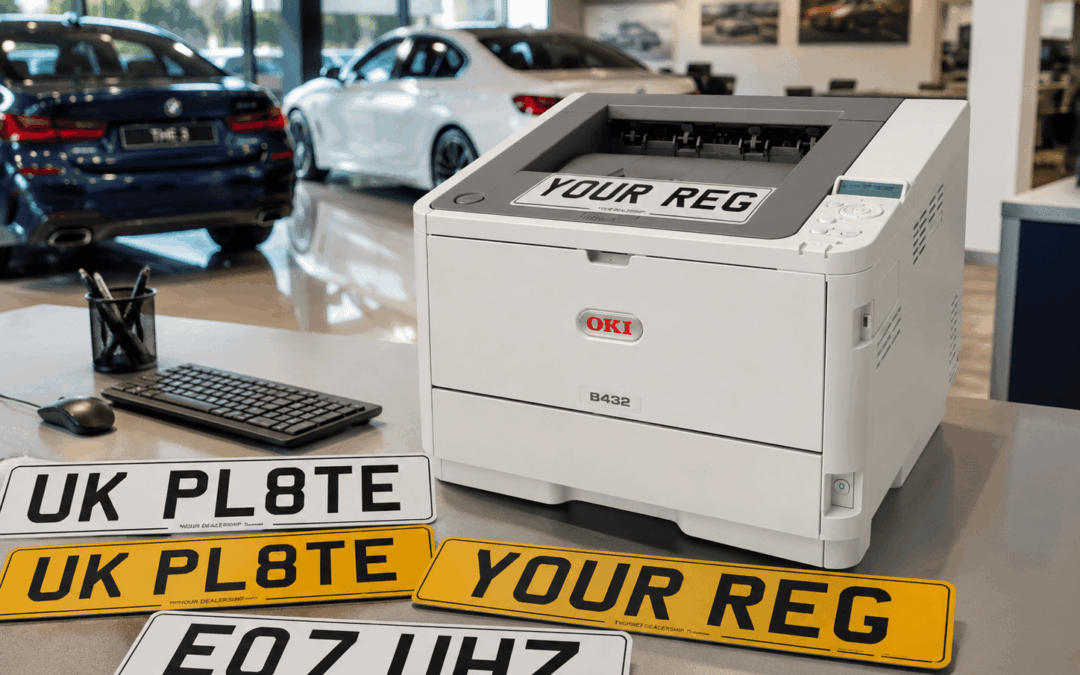
If you are a motor trade professional, a vehicle accessory retailer, or a garage that makes and fits number plates, bringing your plate printing in-house can save significant time and money compared to ordering from an outside supplier. The right number plate printer gives you control over turnaround, reduces your dependency on third parties, and allows you to respond to customer needs immediately — all without a large capital outlay.
This guide covers what to look for in a number plate printer, which OKI models are most commonly used for in-house plate production, and how to set up a compliant number plate printing workflow. You can browse our full range of number plate printers and related products at OKI Supplies.
What Is a Number Plate Printer?
A number plate printer is typically a colour LED or laser printer capable of printing directly onto the reflective acrylic or plastic sheet material used to produce vehicle registration plates. Unlike standard office printing, number plate production involves specialist substrates, specific font and layout requirements (mandated by UK law), and a need for print durability that standard office printers are not designed to deliver.
The most widely used number plate printer technology in the UK motor trade is OKI’s LED print engine, which offers several advantages over laser for this application:
Consistent registration accuracy — OKI LED technology maintains precise colour registration across the print area because there is no scanning laser mechanism to drift. For number plate printing where character alignment must be exact, this consistency matters.
Ability to handle specialist media — OKI LED printers support a wider range of media weights and types than many office lasers, including the heavy acrylic-backed and reflective substrates used in number plate production.
Durability of output — Toner-based printing produces an output that is fused into the substrate rather than sitting on the surface, giving better resistance to abrasion and weathering than inkjet alternatives.
Which OKI Printer Is Used for Number Plate Printing?
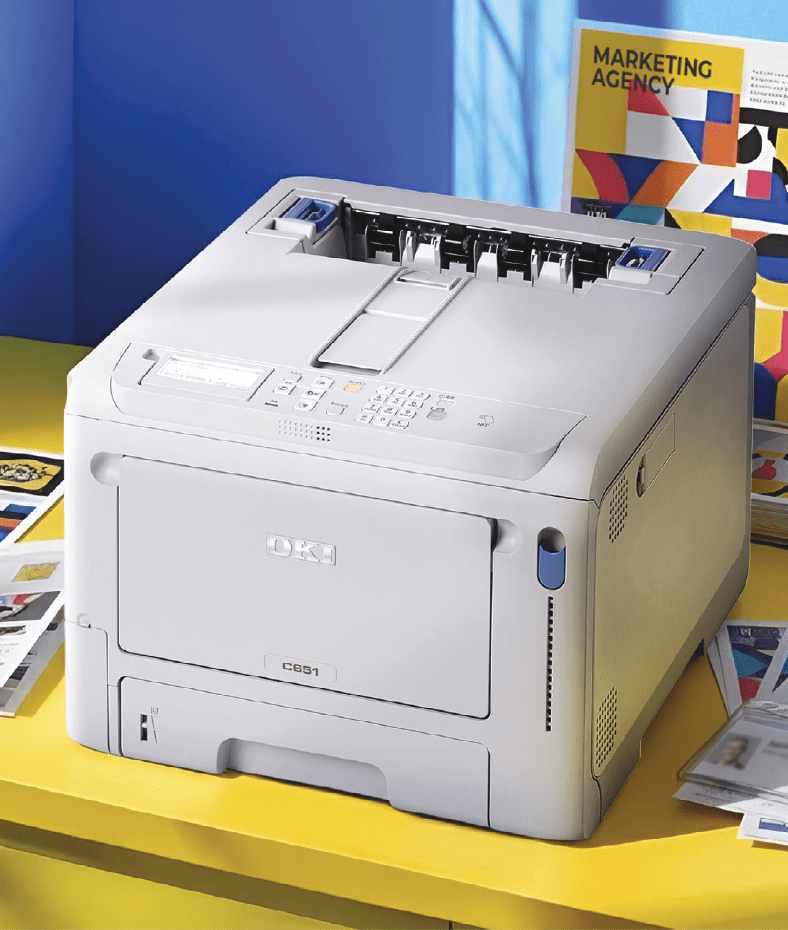
The OKI C650 and its successor, the OKI C651dn, are among the most widely used LED printers in the UK number plate industry. Their combination of A4 print capability, heavy media support (up to 256gsm), and reliable LED print engine makes them well-suited to the demands of number plate production.
The OKI C651dn specifically is often paired with specialist number plate printing software and plate material kits to create a complete in-house printing solution. The printer handles the text, the supplier provides the reflective plate blanks and overlaminate, and the result is a compliant, professionally produced plate that meets the BSAU 145e standard.
Key features that make the OKI C651dn suitable for number plate printing include:
A4 format capability — Standard UK number plates are produced at A4 size (520 x 111mm for rear plates, slightly different for front), making an A4-format printer the natural choice.
Heavy media support — The ability to feed and print on media up to 256gsm ensures compatibility with the substrates used in plate production.
LED precision — Accurate character sizing and spacing is critical for legal compliance, and OKI’s LED technology delivers this consistently.
Network connectivity — The C651dn includes Gigabit Ethernet as standard, allowing it to be shared across multiple workstations in a busy showroom or workshop environment.
Legal Requirements for Number Plate Printing in the UK
Before setting up an in-house number plate printing operation, it is essential to understand the legal framework that governs plate production in the UK. Number plates must comply with the British Standard BSAU 145e (previously BSAU 145d), which specifies:
Font requirements — Only the Charles Wright typeface (or an approved equivalent) may be used for UK vehicle registration plates. Character sizing and spacing are also prescribed by the standard.
Reflectivity — Plates must use retro-reflective materials meeting specified performance levels. You cannot simply print onto any white or yellow sheet — the substrate must be a compliant reflective plate blank.
Supplier registration — Anyone supplying number plates to the public must be registered with the DVLA as a number plate supplier (NPS). This requires a DVLA registration, secure record-keeping of customer identity verification, and compliance with DVLA guidelines on personalised registrations.
Marking requirements — Plates must display the British Standard mark, the manufacturer or supplier’s name, and the post code of the supplying business.
Failure to comply with these requirements can result in significant fines and, in serious cases, criminal prosecution. If you are new to number plate production, we strongly recommend reviewing the DVLA’s guidance on plate supplier registration before getting started.
Setting Up Your Number Plate Printing Workflow
A complete in-house number plate printing setup typically consists of the following components:
1. The printer — An OKI C651dn or similar LED printer capable of handling the required media.
2. Plate printing software — Specialist software that generates plates to the correct dimensions, font, and layout specifications. Several UK suppliers offer this as part of a complete kit.
3. Plate blanks — Reflective acrylic or polycarbonate plate blanks in front (white) and rear (yellow) variants. These are sourced from DVLA-registered plate material suppliers.
4. Overlaminate — A clear protective laminate applied over the printed surface to protect against UV, abrasion, and weathering.
5. A laminator — To apply the overlaminate evenly. Many number plate suppliers offer cold-peel laminators designed specifically for this application.
Some suppliers offer complete number plate printing kits that bundle software, plate blanks, and laminate together, which can simplify the setup process for new entrants to in-house plate production.
Number Plate Printer Consumables and Running Costs
Running costs for a number plate printer are primarily determined by the cost of the toner consumables and the plate blanks. The OKI C651dn uses the same toner cartridges as the C650, which are widely available and competitively priced.
For high-volume plate printing, the high-yield toner variants offer a meaningfully lower cost per page and are generally the more economical choice. Genuine OKI consumables are recommended to maintain print quality and avoid issues with character definition and tonal consistency that can arise with compatible alternatives.
You can find the full range of OKI C650 and C651 consumables, including toners, drums, and the fuser and transfer belt units that are essential for long-term reliability, in the OKI Supplies number plate printer section.
Why Choose OKI Supplies for Your Number Plate Printer?
OKI Supplies is a specialist OKI consumables and printer retailer with years of experience supporting the UK motor trade and number plate industry. We can help you select the right printer for your volume and application, and we stock a comprehensive range of genuine OKI consumables to keep your operation running without interruption.
Whether you are setting up your first in-house number plate printing system or replacing aging equipment in an established operation, our team is here to help. Explore our number plate printer range or get in touch for personalised advice on the right setup for your business.

 Take control of small-format packaging such as seed packets, paper bags and compact boxes. Digital LED technology
 Produce premium greeting cards, invitations and stationery on textured, smooth, matt or gloss boards. Achieve
 Enter the short-run flexible packaging space by printing directly onto pre-made, toner-receptive barrier pouches.
 Support automotive workflows with road-legal number plates on approved reflective media (follow current DVLA/BSAU
 Launch on-demand, short-run sleeves, belly bands and mini-cartons with rich colour and sharp micro-type for